Why Sketches and Mood Boards Are Costing Your Studio Approvals: The Case for Photorealistic Visualisation
Sinan Alajrad, Founder & Creative Director of SinanDesigns, partnering with interior design studios to create 3D visualisation that improves presentation clarity and speeds approvals.
The invisible barrier to project approval
In high-end interior design, the gap between what the studio sees and what the client understands is rarely discussed. Yet it is one of the most expensive problems a studio faces. Many studios continue to rely on presentation tools that actively work against client confidence: flat mood boards and basic line drawings.
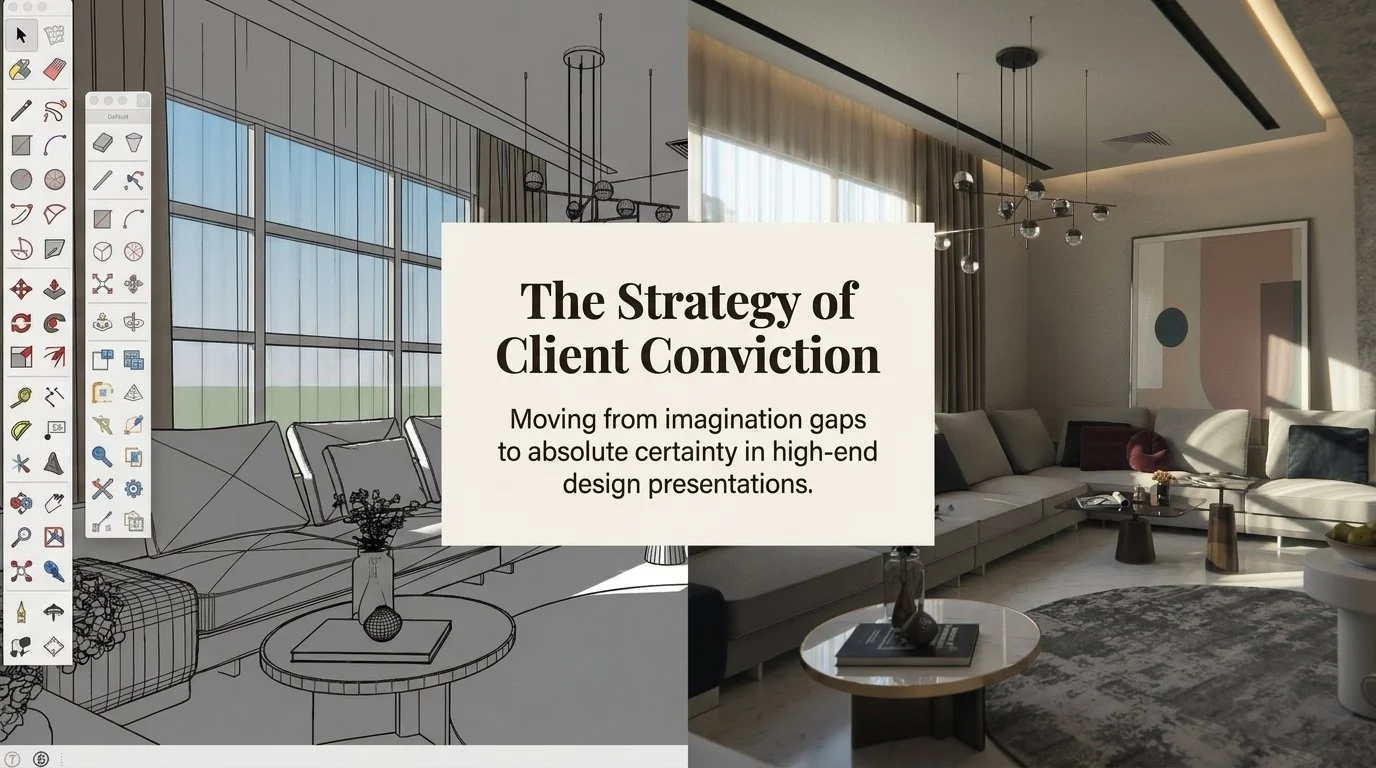
The core problem is straightforward. Forcing a high-value client to imagine a space before committing to it is a significant business risk. When a designer looks at a line drawing, they see resolved spatial intent. When a client looks at the same drawing, they see uncertainty. When you ask a client to fill in the blanks of a six-figure investment decision, they do not fill them with excitement. They fill them with doubt.
If a client cannot feel the spatial volume, the weight of the materials, or the quality of the light, they cannot confidently say yes. Removing the burden of imagination is not an aesthetic choice. It is a commercial one.
Why Sketches and Mood Boards Are Costing Your Studio Approvals: The Case for Photorealistic Visualisation
Why mood boards are the most expensive mistake on approval day
Mood boards are often beautiful. A carefully assembled palette of honed bronze, sandblasted concrete, natural wood veneer, and wool-textured fabric communicates a designer's intent clearly within the studio. But a material list is a technical instruction, not a design conversation.
Tactile swatches and flat samples are essential to the studio's internal process. They fail, however, to communicate a finished and lived-in vision to a client who has not been trained to assemble those textures into a cohesive environment in their mind.
When a presentation depends entirely on flat components, the studio is asking the client to perform a professional task they are not equipped for. Visual ambiguity is the primary cause of approval hesitation. And hesitation, left unresolved, becomes delay, revision, and eroded trust.
From SketchUp grey to spatial certainty
From SketchUp grey to spatial certainty
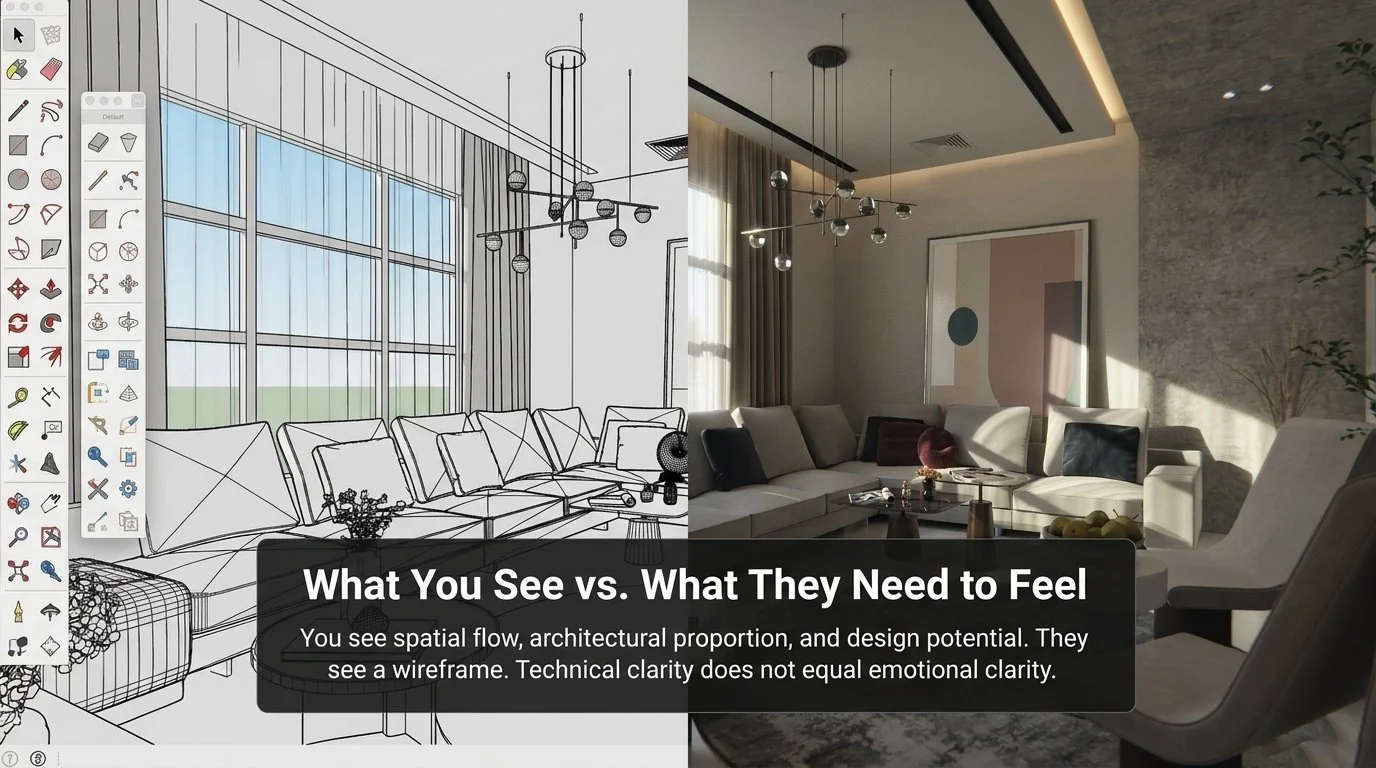
There is a significant psychological difference between the cold linework of an untextured 3D model and the warmth of a cinematic, photorealistic render. In the visual ambiguity phase, clients are confronted with grey geometry and clinical spatial outlines. They see the what. They are left guessing at the how.
Photorealistic visualisation resolves this uncertainty by demonstrating exactly how light behaves across a specific surface. It replaces a generic wall with the rhythmic depth of fluted timber panels and the quiet glow of integrated LED strip lighting. It replaces a seating plan with the physical presence of sculptural lounge chairs on a circular rug, in the exact material finish the designer has specified.
Photorealism closes the gap before the client meeting even begins. It shifts the conversation from "what will this look like?" to "how soon can we move forward?"
Why Sketches and Mood Boards Are Costing Your Studio Approvals: The Case for Photorealistic Visualisation
Photorealistic visualisation as a commercial tool
Visualisation is often framed as an aesthetic add-on, something that makes the presentation look more impressive. That framing undersells its real function.
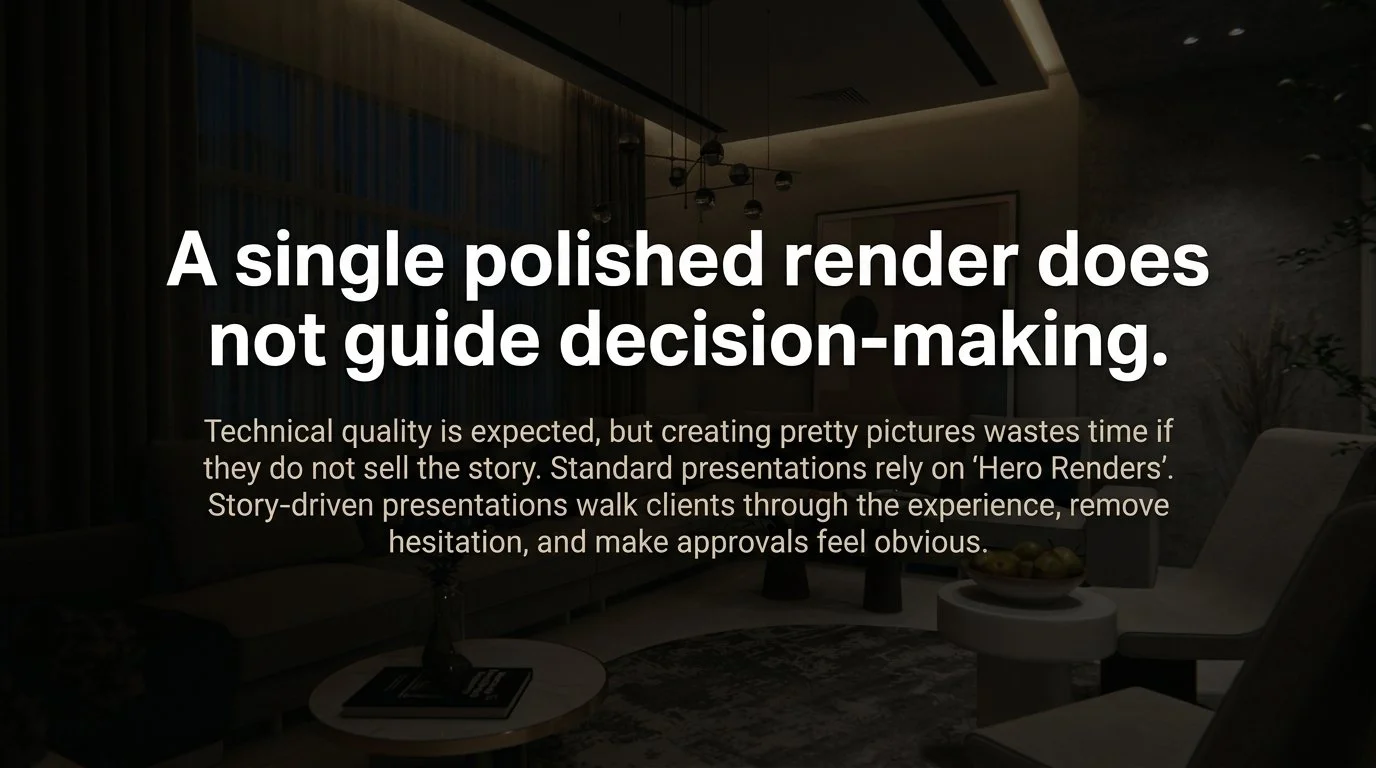
High-quality visualisation is a commercial tool designed to make approvals feel straightforward. The strategic benefits are measurable.
Timeline compression. Eliminating the "let me think about it" phase moves projects into procurement and production weeks ahead of schedule.
Revision reduction. Clients who can see the resolved design respond with specific, actionable feedback rather than vague requests for change. Revision cycles shorten because the starting point is clear.
Confidence at the point of commitment. When a client can see the finished environment, the psychological barriers to signing off are removed. The decision feels obvious rather than risky.
The craft behind conviction: lighting and composition
Producing visualisation that converts requires more than technical software proficiency. It requires design intelligence applied to every decision in the scene.
A single lighting decision changes the emotional reading of an entire space. An evening scene with warm temperatures and directional shadows creates a sense of sanctuary that a bright midday render cannot. Strategic placement of pendant lighting provides atmospheric depth that signals quality and comfort without stating it directly.
Compositional choice is equally deliberate. A low camera angle places the viewer inside the space rather than observing it from above. It creates a visceral sense of scale, guides the eye through the room, and makes the experience feel personal rather than diagrammatic. These decisions demonstrate that the visualiser understands the project's intent, not just its geometry.
Why Sketches and Mood Boards Are Costing Your Studio Approvals: The Case for Photorealistic Visualisation
Breaking the revision cycle: a practical example
A project that had stalled for six weeks due to an unclear visual brief is a pattern many studios will recognise. The client was uncertain. The studio was sending updated drawings and revised mood boards. The cycle continued without resolution.
The shift came when photorealistic renders replaced the flat presentation entirely. Once the client could see the precise interaction of brushed walnut against sandblasted concrete, the specific quality of light across the material surfaces, and the spatial atmosphere of the resolved design, the uncertainty was gone. The project moved into production within days.
That shift reframes the visualiser's role. It is not a render factory. It is a thinking partner that understands the commercial pressure behind the design process.
Briefing for intent, not just instruction
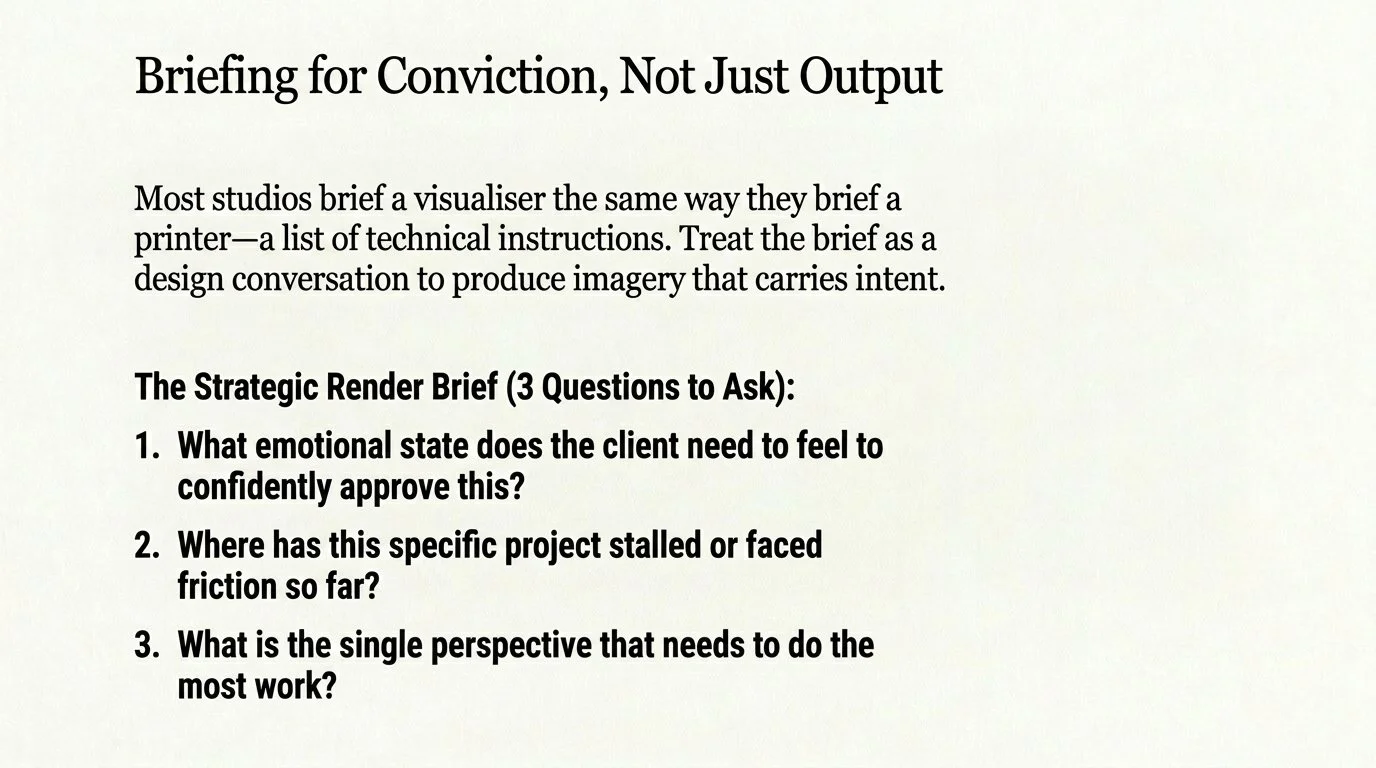
If you want approvals that feel effortless, the briefing process must go beyond a list of materials and camera angles. Imagery that carries design intent requires a conversation about what the client needs to feel in order to be confident.
Before your next presentation, consider three questions.
What does the client need to feel to say yes? Are you selling safety, status, or a sense of sanctuary?
Where has the project stalled so far? What specific moment in the presentation is generating the most hesitation?
What is the single image that needs to do the most work for this project?
The era of imagination-heavy presentations has passed. When you provide total visual clarity, you provide the only reliable path to a confident and committed yes.
Why Sketches and Mood Boards Are Costing Your Studio Approvals: The Case for Photorealistic Visualisation
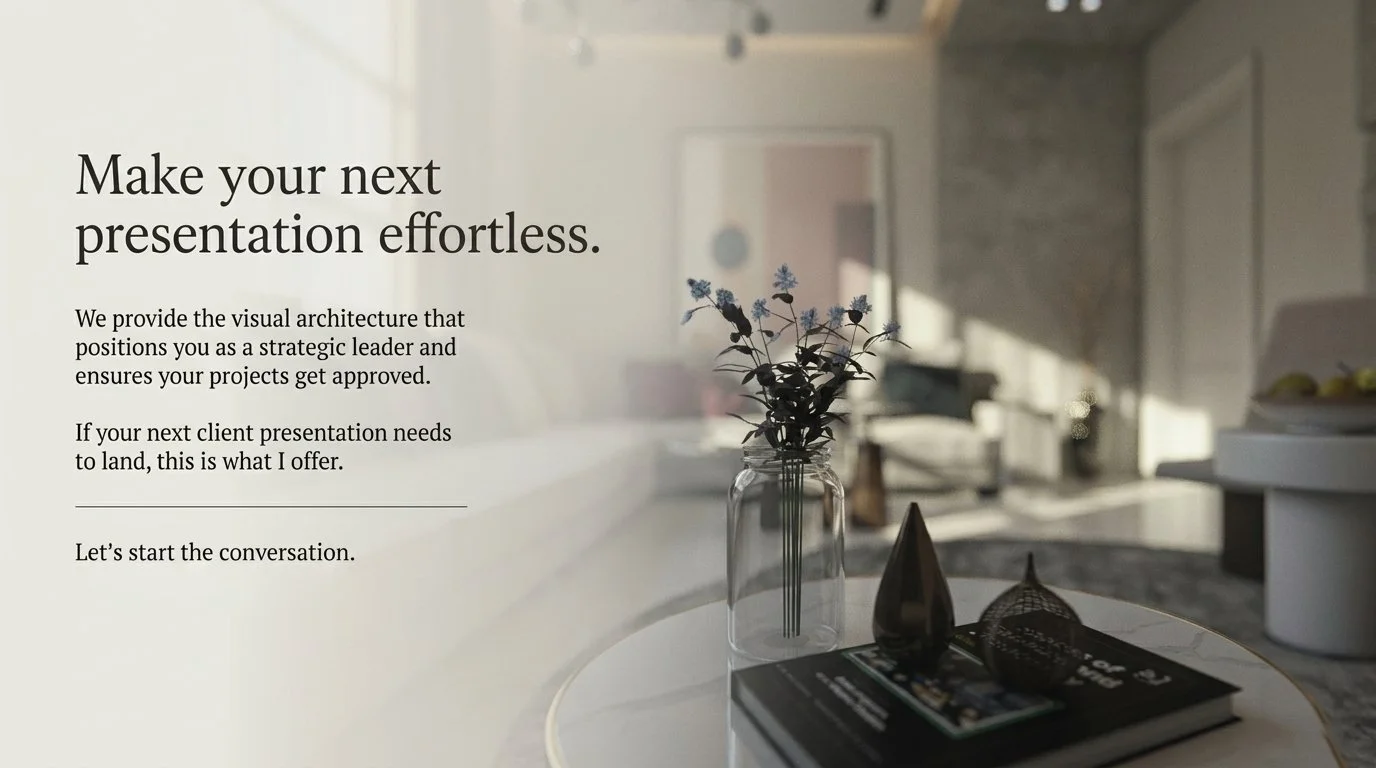
Work with a visualisation partner who understands design, not just software.
SinanDesigns works with interior design studios in Adelaide and across Australia to produce 3D visualisation that strengthens presentations, reduces revision cycles, and helps clients make confident decisions.
Explore the portfolio at sinandesigns.com.au/portfolio or book a free 15-minute consultation to discuss your next project.
Frequently Asked Questions
Why are mood boards not enough for client approvals? Mood boards present individual materials in isolation. They require the client to mentally assemble those elements into a finished environment, a task most clients are not trained for. The result is visual ambiguity, which creates hesitation and delays. Photorealistic 3D visualisation removes this burden by showing the finished design as a resolved, lived-in image.
How does 3D visualisation reduce design revision cycles? When clients respond to a photorealistic image rather than a drawing or mood board, their feedback is specific and grounded in what they can see. Vague requests for change are replaced by precise, actionable input. This reduces revision rounds significantly and moves projects toward approval more efficiently.
What is the difference between a 3D render and a mood board? A mood board assembles reference materials and sample swatches to communicate a design direction. A 3D render is a photorealistic digital image of the actual proposed space, showing the correct materials, lighting, furniture, and finishes as they will appear in the finished environment.
Can photorealistic visualisation speed up project approvals? Yes. When clients can see the resolved design clearly, decision-making becomes faster and more confident. The approval stage shifts from negotiation and imagination to straightforward confirmation of what the client has already seen and responded to positively.
Why Sketches and Mood Boards Are Costing Your Studio Approvals: The Case for Photorealistic Visualisation
Sinan Designs is a 3D interior visualisation studio based in Stepney, Adelaide, South Australia. The studio produces photorealistic render packages for interior design studios, architects, and property developers across Adelaide and Australia-wide.