What Is 3D Interior Visualisation? A Complete Guide for Australian Design Studios and Property Developers
Sinan Alajrad, Founder & Creative Director of SinanDesigns, partnering with interior design studios to create 3D visualisation that improves presentation clarity and speeds approvals.
Definition
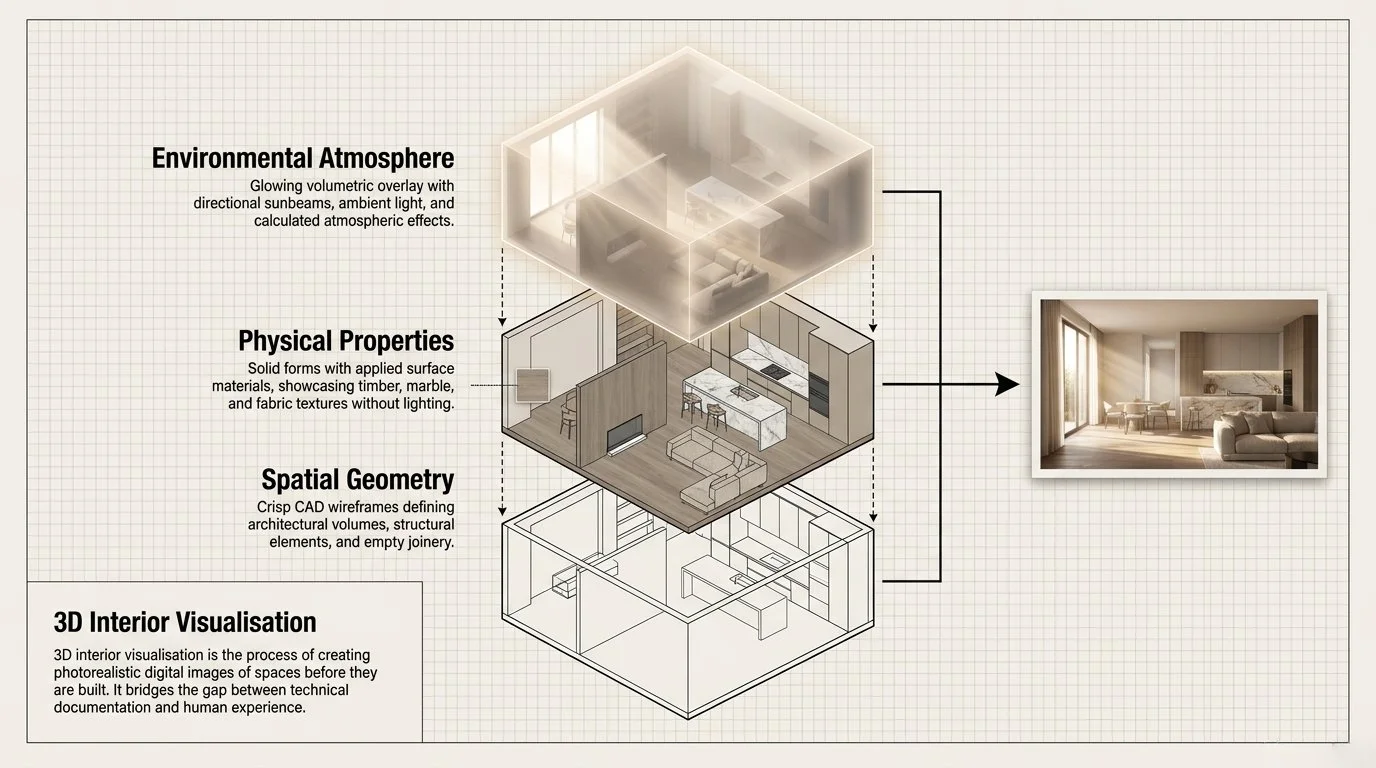
3D interior visualisation is the process of creating photorealistic digital images of interior spaces before they are built or renovated. Using specialist software, a visualisation artist constructs a three-dimensional model of a room or building interior, applies accurate materials and lighting, and renders the result as a high-resolution image or animation.
The output, commonly called a 3D render or interior render, allows clients, architects, designers, and developers to see exactly how a space will look before any physical construction begins.
In Australia, 3D interior visualisation is used across residential design, commercial fit-outs, hospitality projects, retail environments, and property development to support client presentations, development approvals, pre-sales campaigns, and marketing materials.
A Complete Guide for Australian Design Studios and Property Developers
How 3D Interior Visualisation Works
The production of a 3D interior visualisation typically follows a structured process:
1. Brief and file intake: The designer or client provides CAD files (DWG or DXF format), floor plans, elevations, and material specifications. A briefing call clarifies design intent, preferred atmosphere, camera angles, and key moments to capture.
2. 3D modelling: A digital model of the space is constructed using the supplied drawings as reference. Furniture, joinery, architectural elements, and fixtures are modelled or sourced from specialist 3D asset libraries.
3. Material and lighting development: Surface materials — timber, stone, fabric, glass, metal — are applied with accurate physical properties. Lighting is developed to reflect the intended mood of the space, whether natural daylight, artificial evening light, or a combination.
4. Rendering: The completed 3D scene is processed through a render engine, which calculates how light interacts with every surface. This is the computationally intensive stage that produces the final photorealistic image.
5. Review and refinement: The initial render is reviewed by the studio or client. Adjustments to composition, materials, lighting, or camera angle are made before final high-resolution images are delivered.
Industry-standard software used in Australia includes 3ds Max, V-Ray, FStorm, D5 Render, Lumion, and Enscape.
A Complete Guide for Australian Design Studios and Property Developers
Types of 3D Interior Visualisation
Still renders
Single photorealistic images of a space, typically from one or more carefully chosen camera angles. Still renders are the most common deliverable and are used for client presentations, approval submissions, and marketing.
Render packages
A curated set of 6–12 still renders covering key spatial moments across a project — entry sequence, hero living spaces, material details, day and night conditions. Designed to function as a complete visual story for a single presentation.
Day-to-night sequences
Pairs of renders showing the same space under daylight and evening lighting conditions. Used to demonstrate how artificial lighting design performs and how a space changes character across the day.
3D walkthroughs and animations
A moving sequence through a space, typically rendered as a video file. Used for marketing campaigns, developer pre-sales, and presentations where a static image cannot convey circulation or spatial flow.
Virtual reality (VR) renders
Interactive 3D experiences that allow a viewer to move through a rendered space in real time using a VR headset. Used for high-value residential and commercial projects where immersive client engagement is required.
Clay renders (neutral pass)
Renders produced without final materials applied, using a uniform neutral tone across all surfaces. Used in the approval workflow to evaluate spatial proportion, lighting direction, and composition before committing to final finishes.
Who Uses 3D Interior Visualisation in Australia
Interior design studios
Interior designers use 3D visualisation to present concepts to clients before construction begins. Photorealistic renders help clients understand material palettes, spatial atmosphere, and design intent, reducing hesitation and revision cycles during the approval process.
Architects
Architectural practices use interior renders alongside exterior visualisation to present the full experience of a proposed building. For complex or high-value projects, interior renders help communicate design intent to clients, planning authorities, and development partners.
Property developers
Developers use 3D interior renders to support pre-sales of off-the-plan apartments, townhouses, and commercial properties. Buyers and investors are more likely to commit to a purchase when they can see the finished interior clearly, rather than relying on floor plans and specifications alone.
Builders and construction companies
Builders use renders to present proposed finishes and fitout options to clients, support display suite imagery, and differentiate their offering in competitive tender situations.
Retail and hospitality operators
Retail brands and hospitality operators use 3D visualisation to present proposed store designs or venue fit-outs to leasing agents, mall operators, franchise partners, and development approval authorities.
A Complete Guide for Australian Design Studios and Property Developers
Key Benefits of 3D Interior Visualisation
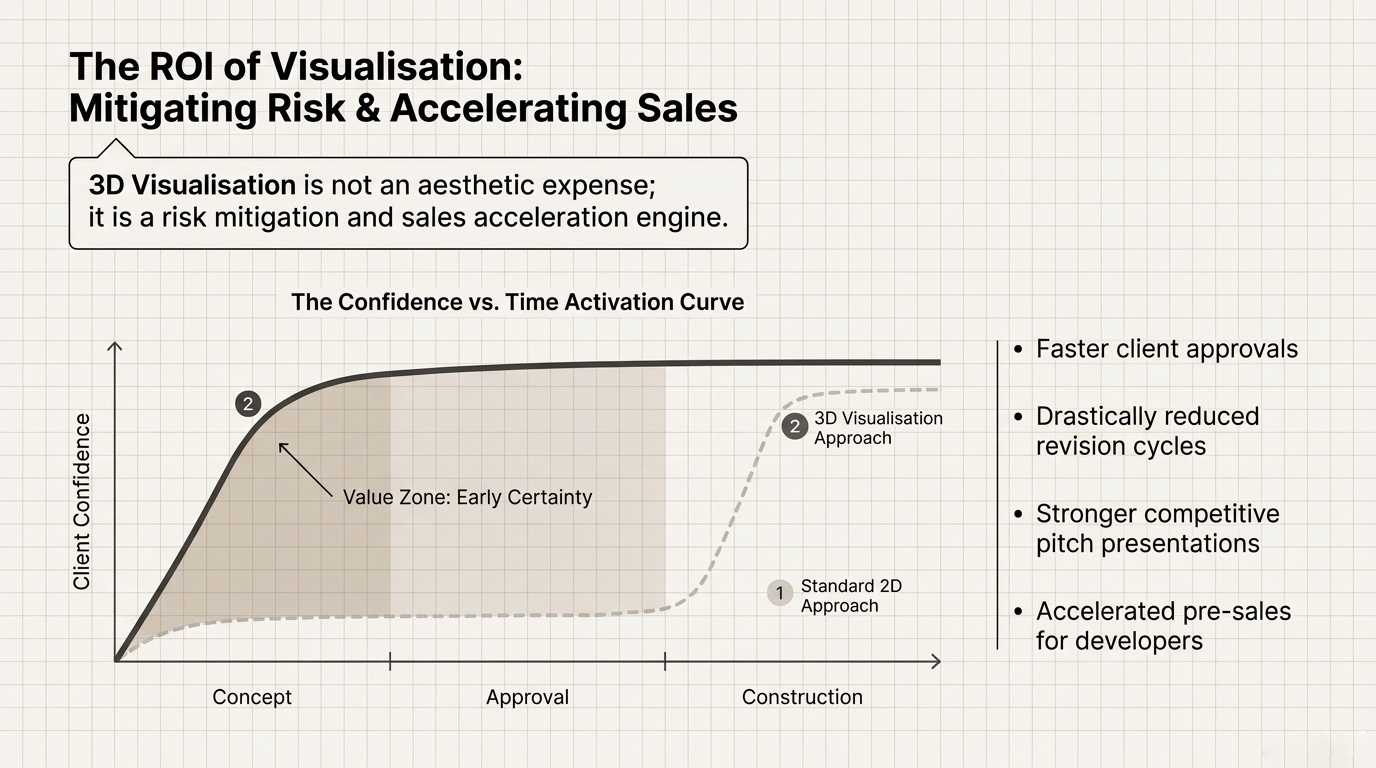
Faster client approvals When clients can see a photorealistic image of the proposed design, decision-making becomes faster and more confident. Uncertainty, the primary cause of approval delays, is reduced because the client is no longer being asked to imagine the outcome.
Fewer revision cycles Presenting a photorealistic render early in the design process surfaces questions and concerns before they become expensive changes. Clients can respond to what they see, rather than what they assume, leading to more specific and actionable feedback.
Stronger client presentations A high-quality render communicates the value and quality of a design more effectively than plans, elevations, or mood boards alone. This is particularly important in competitive pitch situations, where the studio that presents most clearly often creates stronger confidence.
Pre-sales and marketing support For property developers, interior renders are a core marketing asset. They appear in advertising campaigns, on real estate platforms, in display suites, and in investor presentations, often before a single wall has been built.
Development approval submissions In Australia, many local councils and development authorities require visualisation as part of a planning or development approval submission. Interior renders help demonstrate how a proposed fitout will impact heritage buildings, mixed-use precincts, or sensitive urban environments.
3D Interior Visualisation Costs in Australia
Pricing for 3D interior visualisation in Australia varies based on the complexity of the space, the number of views required, the level of detail needed, and the turnaround time.
As a general guide:
Service type Typical range (AUD) Single interior still render $400 – $1,200Render package (6–10 views) $2,000 – $6,000+ Day/night sequence (per space) $800 – $2,0003D walkthrough animation (60 sec) $3,000 – $10,000+ Property developer package $5,000 – $20,000+
Factors that increase cost include complex architectural geometry, custom furniture and joinery modelling, large numbers of camera angles, animation, virtual reality output, and rush turnaround requirements.
Studios that provide incomplete briefs or low-resolution drawings typically incur additional modelling time, which increases cost. A well-prepared brief with complete CAD files, material specifications, and clear design intent is the most effective way to keep a project on budget.
A Complete Guide for Australian Design Studios and Property Developers
How to Choose a 3D Visualisation Studio in Australia
When selecting a 3D visualisation provider, consider the following:
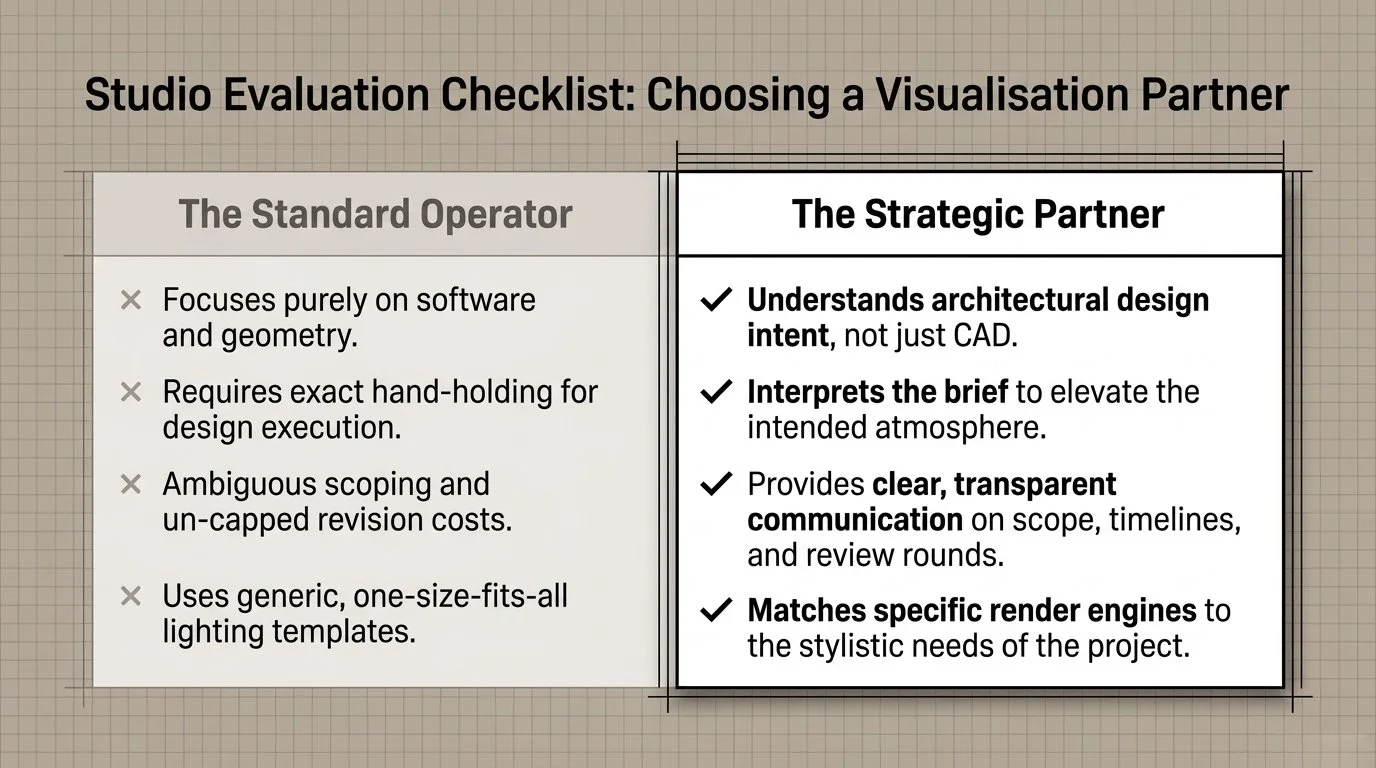
Portfolio quality and style match: Review the studio's existing work to assess whether the visual style, material accuracy, and lighting quality match the standard your project requires. A studio that specialises in residential interiors may not be the best fit for a commercial hospitality brief.
Understanding of design intent: The best visualisation studios understand design, not just software. A provider with a background in interior design or architecture will ask better questions, interpret the brief more accurately, and produce imagery that captures the intent of the design. not just its geometry.
Communication and process clarity: A reliable studio will define the scope, timeline, revision rounds, and deliverable format clearly before work begins. Ambiguity in the brief stage typically leads to misaligned expectations and additional revision costs.
Turnaround time: Standard turnaround for a 3D interior render package in Australia is 5–10 business days from brief sign-off. Rush turnaround is available from most studios at a premium. Confirm timelines in writing before committing.
Software capability: Industry-standard tools include 3ds Max, V-Ray, FStorm, D5 Render, Lumion, and Enscape. Different engines produce different visual qualities and are suited to different project types. Ask which engine the studio uses and why.
3D Interior Visualisation in Adelaide
Adelaide has a growing market for 3D interior visualisation, driven by active residential construction, boutique hospitality development, and a strong community of independent interior design studios.
Interior design practices across Adelaide's inner suburbs, including Norwood, Unley, Prospect, and the CBD, are increasingly using photorealistic visualisation as a standard part of their client presentation process, replacing or supplementing physical mood boards, material samples, and basic sketch renders.
For Adelaide studios working with clients across South Australia, interstate, or internationally, 3D visualisation provides a communication tool that works regardless of geography, allowing clients to understand and approve designs remotely with the same confidence as an in-person presentation.
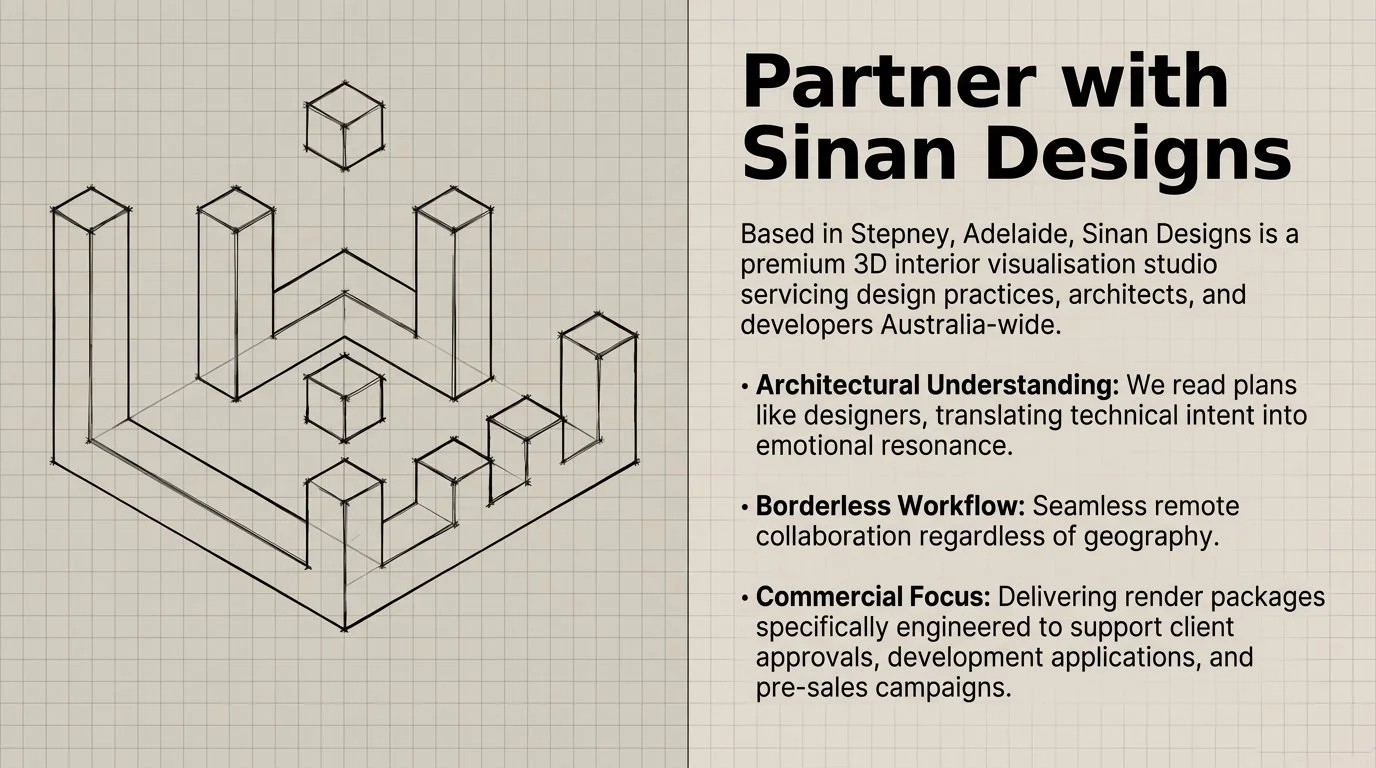
Sinan Designs is a 3D interior visualisation studio based in Stepney, Adelaide. The studio works with interior design practices, architects, and property developers across Adelaide and Australia-wide, producing photorealistic render packages that support client presentations, development approvals, and pre-sales campaigns.
Frequently Asked Questions
What is 3D interior visualisation? 3D interior visualisation is the creation of photorealistic digital images of interior spaces before they are built. It uses specialist 3D modelling and rendering software to show how a space will look, including materials, lighting, furniture, and atmosphere.
How long does a 3D interior render take in Australia? A standard render package typically takes 5–7 business days from brief sign-off. Rush turnaround of 2–3 days is available from many studios at a premium. Complex projects with custom modelling requirements may take 10–15 business days.
What files does a 3D visualisation studio need to get started? Most studios require CAD files (DWG or DXF), floor plans, elevations, and material or finish specifications. The more complete the documentation, the faster and more accurate the first render preview will be.
What is the difference between 3D visualisation and rendering? The terms are often used interchangeably. Technically, rendering refers to the specific computational process of producing the final image from a 3D scene. Visualisation refers to the broader practice of creating imagery to communicate a design concept. In professional use, both terms describe the same service.
How much does 3D interior visualisation cost in Australia? A single interior render typically costs between $400 and $1,200 AUD. A full render package of 6–10 views typically ranges from $2,000 to $6,000+ depending on complexity, detail level, and turnaround time.
Can 3D visualisation be used for planning and development approvals in Australia? Yes. Many local councils and development authorities accept or require photorealistic visualisation as part of a planning application or development approval submission, particularly for heritage buildings, mixed-use precincts, and sensitive urban sites.
What software is used for 3D interior visualisation in Australia? The most widely used tools are 3ds Max, V-Ray, FStorm, D5 Render, Lumion, and Enscape. The choice of software depends on the project type, lighting complexity, and output format required.
Is 3D interior visualisation only for large projects? No. 3D visualisation is used effectively for single-room residential projects as well as large commercial developments. The decision to use it is typically based on the value of the design decision being supported — where client confidence and approval speed matter, visualisation adds value regardless of project size.
Do 3D visualisation studios in Australia work remotely? Yes. The entire process — brief, file transfer, review, and delivery — runs remotely. Most Australian studios work with clients across multiple states and internationally. Location does not affect quality or communication.
What is the difference between interior and exterior 3D visualisation? Interior visualisation focuses on the inside of a space — room layouts, materials, lighting, furniture, and atmosphere. Exterior visualisation shows the outside of a building — facade, landscaping, street context, and massing. Many projects require both. Some studios specialise in one or the other.
A Complete Guide for Australian Design Studios and Property Developers
Sinan Designs is a 3D interior visualisation studio based in Stepney, Adelaide, South Australia. The studio produces photorealistic render packages for interior design studios, architects, and property developers across Adelaide and Australia-wide.