Why Great Interior Designs Stall, and How 3D Visualisation Speeds Approvals
Sinan Alajrad, Founder & Creative Director of SinanDesigns, partnering with interior design studios to create 3D visualisation that improves presentation clarity and speeds approvals.
In high-end interior design, the problem is rarely a lack of creativity.
More often, great concepts get stuck in the approval loop: brief, clarify, revise, repeat. What should be a confident design process turns into hesitation, extra meetings, and mounting revision rounds.
For interior design studios, that loop is expensive. It stretches timelines, drains creative energy, and chips away at margin.
The issue usually is not that the design is weak. It is that too many questions remain unanswered at the moment the client is asked to decide.
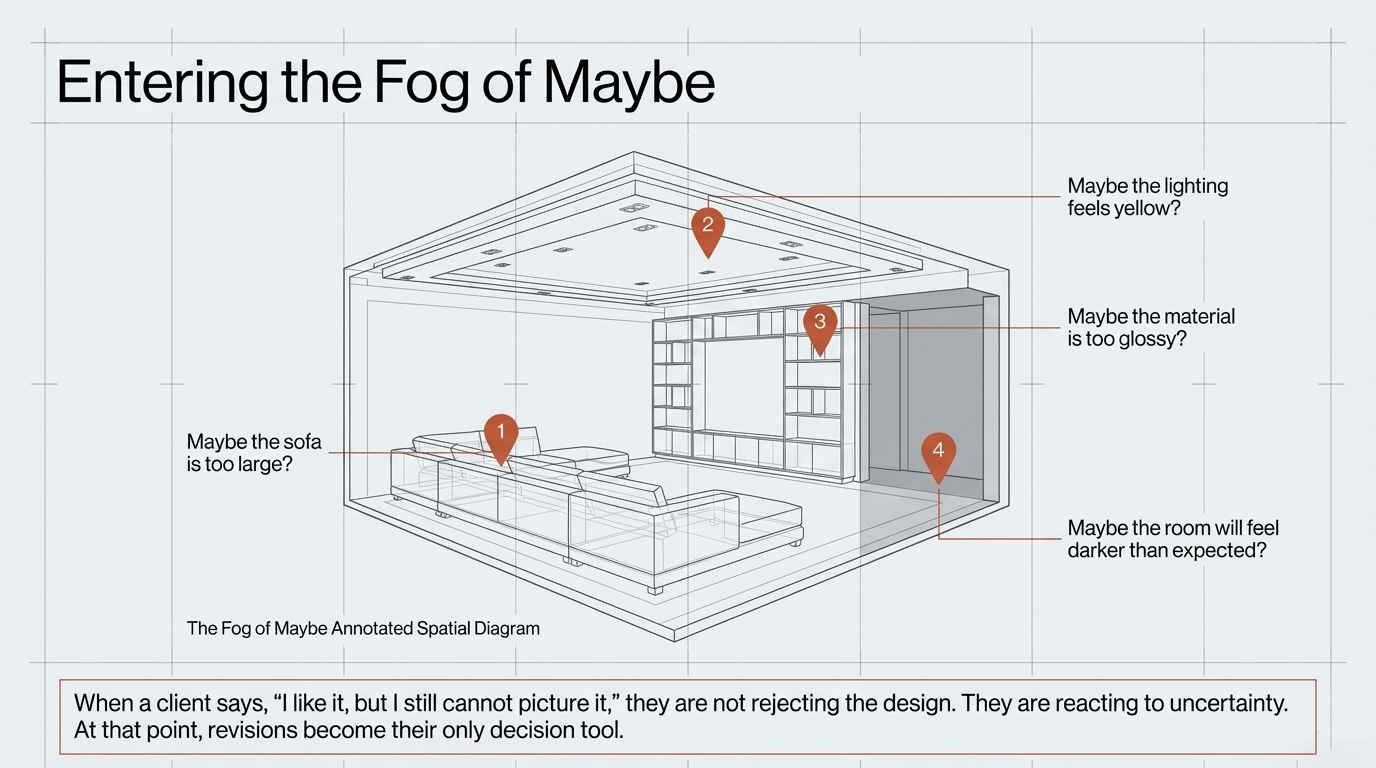
When a client says, “I like it, but I still cannot picture it,” they are not rejecting the design. They are reacting to uncertainty.
That uncertainty is where 3D visualisation becomes strategic.
Used properly, it does more than present a finished concept. It helps interior design studios reduce decision risk, guide feedback, and move clients towards faster, cleaner sign-off.
How 3D Visualisation Helps Interior Designers Win Faster Approvals
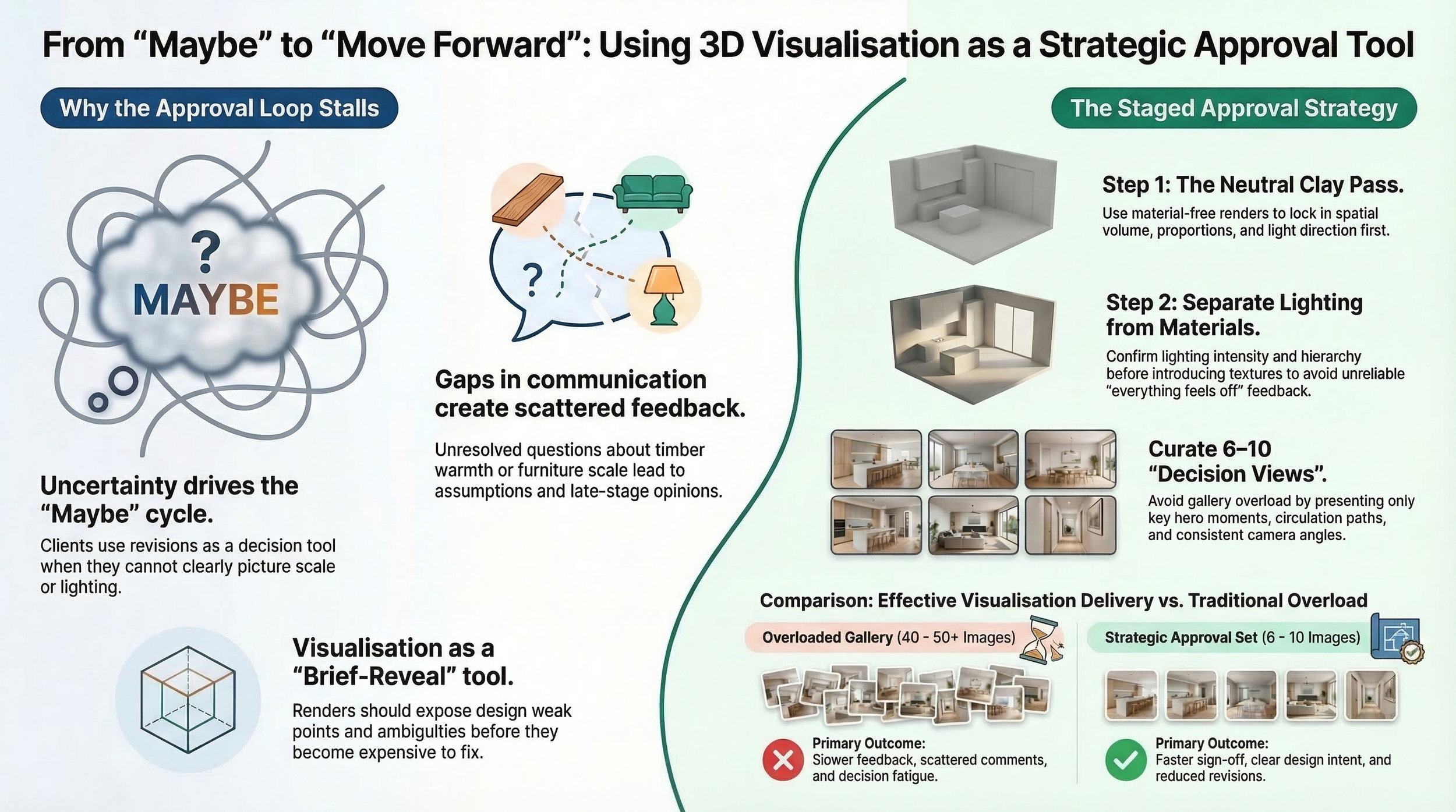
Why interior design approvals stall
Most prolonged revision cycles are not caused by bad design.
They are caused by gaps in communication.
A client may be unsure about the warmth of the timber, the feel of the lighting, the scale of the furniture, or how one zone connects to the next. When those questions are not resolved clearly, feedback becomes scattered. Stakeholders begin filling the gaps with assumptions, preferences, and late opinions.
That is where momentum slips.
A design that looked strong in plan or elevation suddenly enters a fog of “maybe”:
maybe the sofa is too large
maybe the lighting feels yellow
maybe the material is too glossy
maybe the room will feel darker than expected
At that point, revisions become the client’s only decision tool.
How 3D Visualisation Helps Interior Designers Win Faster Approvals
The real job of 3D visualisation
Many studios still treat visualisation as final polish.
In practice, its most valuable role is much earlier.
Good visualisation works as a brief-reveal tool. It exposes ambiguity before ambiguity becomes expensive. It helps the studio identify what still needs to be decided, what can be locked, and what should not be debated yet.
A render cannot rescue a weak brief. But it can reveal the weak points faster, and that gives the design team control.
For example, when a space is modelled with precision, issues that stay hidden in 2D often become obvious:
ceiling depth that feels heavier than expected
wall alignments that miss their intended junctions
feature elements that compete rather than support the composition
circulation that looks elegant on plan but cramped in perspective
That clarity protects both the project and the authority of the studio.
Separate lighting decisions from material decisions
One of the fastest ways to create messy feedback is to ask clients to judge lighting and materials at the same time.
When both are being evaluated together, reactions become unreliable. If a client dislikes the mood of the image, are they reacting to the finish, the lighting, or both?
That is why a staged workflow is so effective.
Step 1, start with a neutral clay pass
A neutral pass removes the distraction of finishes and lets the client focus on spatial volume, proportions, light direction, and overall atmosphere.
Step 2, lock the lighting
Before discussing sheens, textures, or tones, confirm the lighting logic of the space. That means the intensity, warmth, contrast, and focal hierarchy are settled first.
Step 3, move into the material pass
Once the lighting is approved, materials can be judged properly. At that stage, feedback becomes far more precise because the client is no longer reacting to two variables at once.
This single shift can dramatically reduce the “everything feels off” type of review session.
Curate fewer images, get faster decisions
More renders do not automatically create more confidence.
In many cases, they create overload.
A client shown 40 or 50 images is not being guided. They are being asked to process too much. The result is slower feedback, scattered comments, and more room for doubt.
A stronger approach is to deliver a curated approval set of roughly 6 to 10 images.
That set should include:
1. Key decision views
Choose the views that matter most to the layout, mood, and hero moments of the concept.
2. Circulation clarity
Show how the client moves through the space and how one zone connects to the next.
3. Hero material moments
Include close views where premium details need confirmation, especially where texture, joinery, or feature surfaces carry the design identity.
4. Camera consistency
Lock camera angles early. This reduces later comments about perspective distortion or concerns that the design is being “made to look better” through selective framing.
The goal is not to create a gallery. The goal is to create a decision tool.
Use day-to-night transitions to remove atmosphere guesswork
One of the most common causes of hesitation is uncertainty around mood.
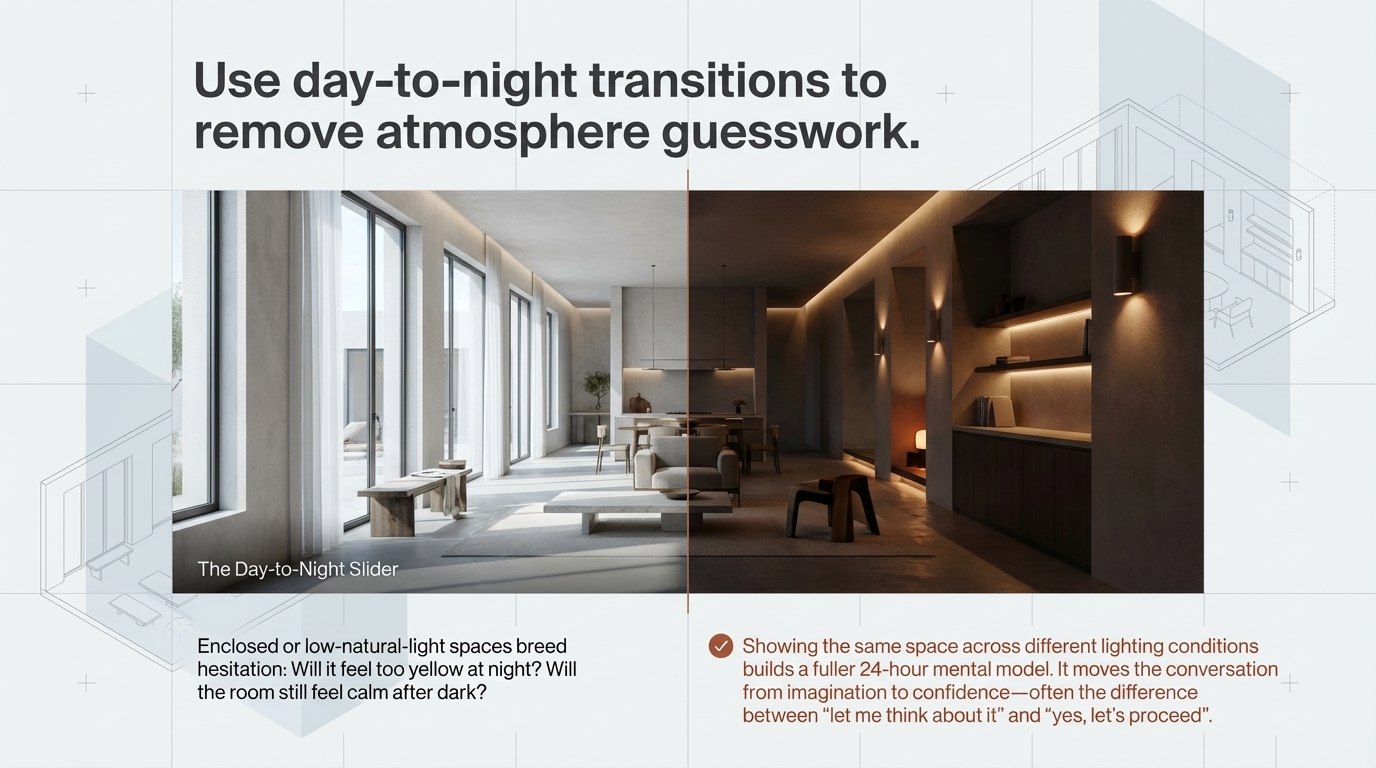
This becomes even more important in enclosed or low-natural-light spaces, where clients often ask questions like:
Will it feel too yellow at night?
Will the room still feel calm after dark?
Will the lighting read as warm or muddy?
A day-to-night visual sequence can answer those questions far better than a verbal explanation.
Showing the same space across different lighting conditions gives the client a fuller mental model of how it will live over 24 hours. It moves the conversation from imagination to confidence.
That confidence is often the difference between “let me think about it” and “yes, let’s proceed”.
How 3D Visualisation Helps Interior Designers Win Faster Approvals
From gallery thinking to approval strategy
Studios do not get faster sign-off by producing more imagery.
They get faster sign-off by improving the order of decisions.
That means:
answering the right questions earlier
separating lighting from materials
using visualisation to expose brief issues
presenting a curated approval set instead of an overwhelming gallery
When 3D visualisation is used this way, it stops being decorative output and starts becoming a strategic tool.
And that is where it creates its real value, not just in beautiful presentations, but in fewer revisions, clearer feedback, and quicker approvals.
Final thought
Great design does not usually stall because it lacks quality.
It stalls because the client cannot confidently see what you already see.
The role of visualisation is to close that gap.
When it does, the conversation changes. The project moves forward with more clarity, less friction, and a much better chance of protecting the original design intent.
FAQ
How does 3D visualisation help interior design approvals?
It helps clients understand the design more clearly, reducing uncertainty around layout, lighting, scale, and materials. That leads to more confident feedback and faster sign-off.
Can 3D visualisation reduce revisions in interior design projects?
Yes. When used as part of a staged approval workflow, 3D visualisation helps answer key questions earlier and prevents vague or reactive revision rounds.
How many renders should an interior design studio present to a client?
In many cases, a curated set of 6 to 10 strong views is more effective than a large gallery. Fewer, better-chosen images reduce overload and guide better decisions.
What is a clay pass in interior visualisation?
A clay pass is a neutral render without final materials. It allows the design team and client to evaluate spatial form and lighting separately from finishes.
If your studio is dealing with slow approvals, revision fatigue, or presentation cycles that keep expanding, I help interior design teams build clearer 3D approval workflows that protect design intent and speed sign-off.