How Better Renders Save Time and Money
Sinan Alajrad, Founder & Creative Director of SinanDesigns, partnering with interior design studios to create 3D visualisation that improves presentation clarity and speeds approvals.
Have you ever presented a design and watched the client hesitate?
They lean forward, study the image, and then say something like:
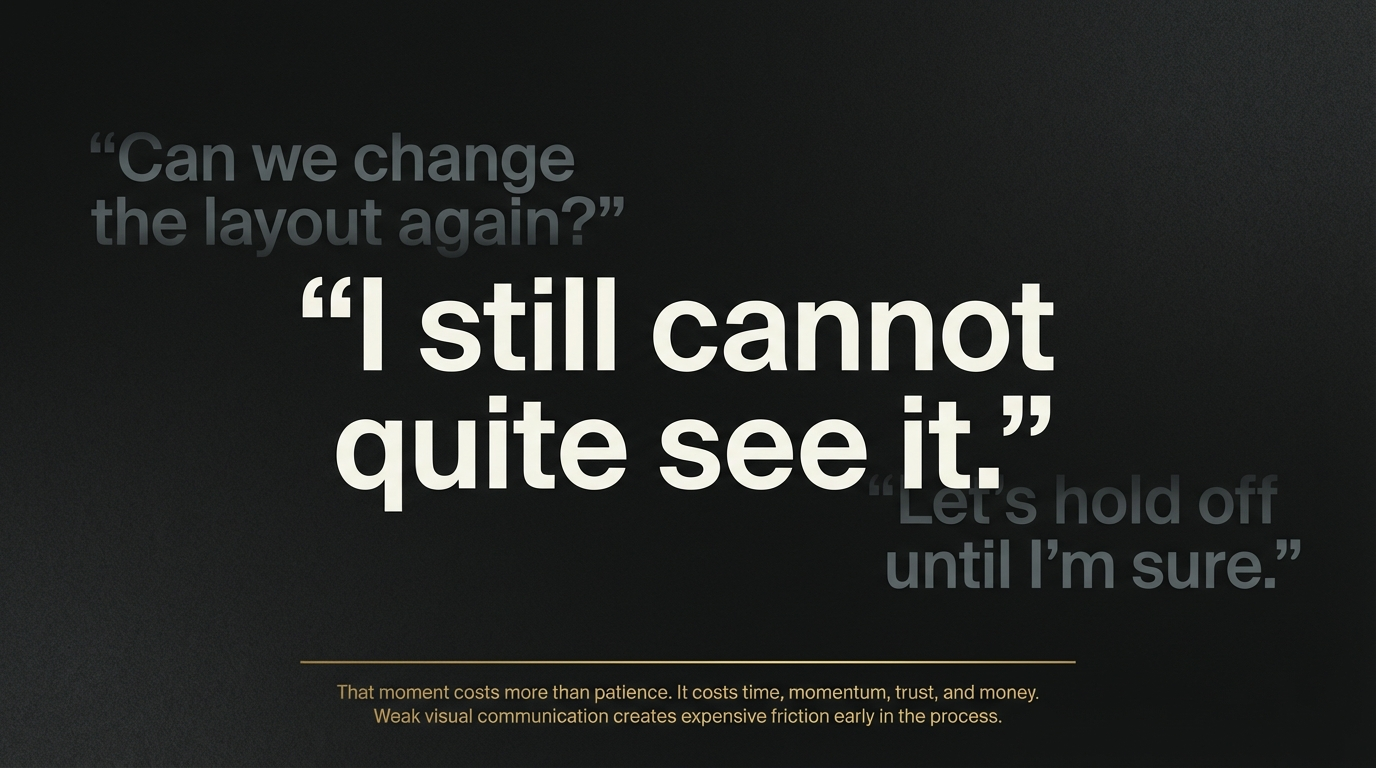
“I still cannot quite see it.”
“Can we change the layout again?”
“Let’s hold off until I’m sure.”
That moment costs more than patience.
It costs time, momentum, trust, and money.
For architects, builders, developers, and interior design studios, weak visual communication often creates expensive friction early in the process. A render may technically show the design, but if it does not help the client feel the space, understand the intent, and make a confident decision, the project can drift into unnecessary revision rounds.
That is where better renders create real value.
Photorealistic visualisation does more than make a project look polished. It helps people understand the design faster, approve it with more confidence, and move forward with less back-and-forth.
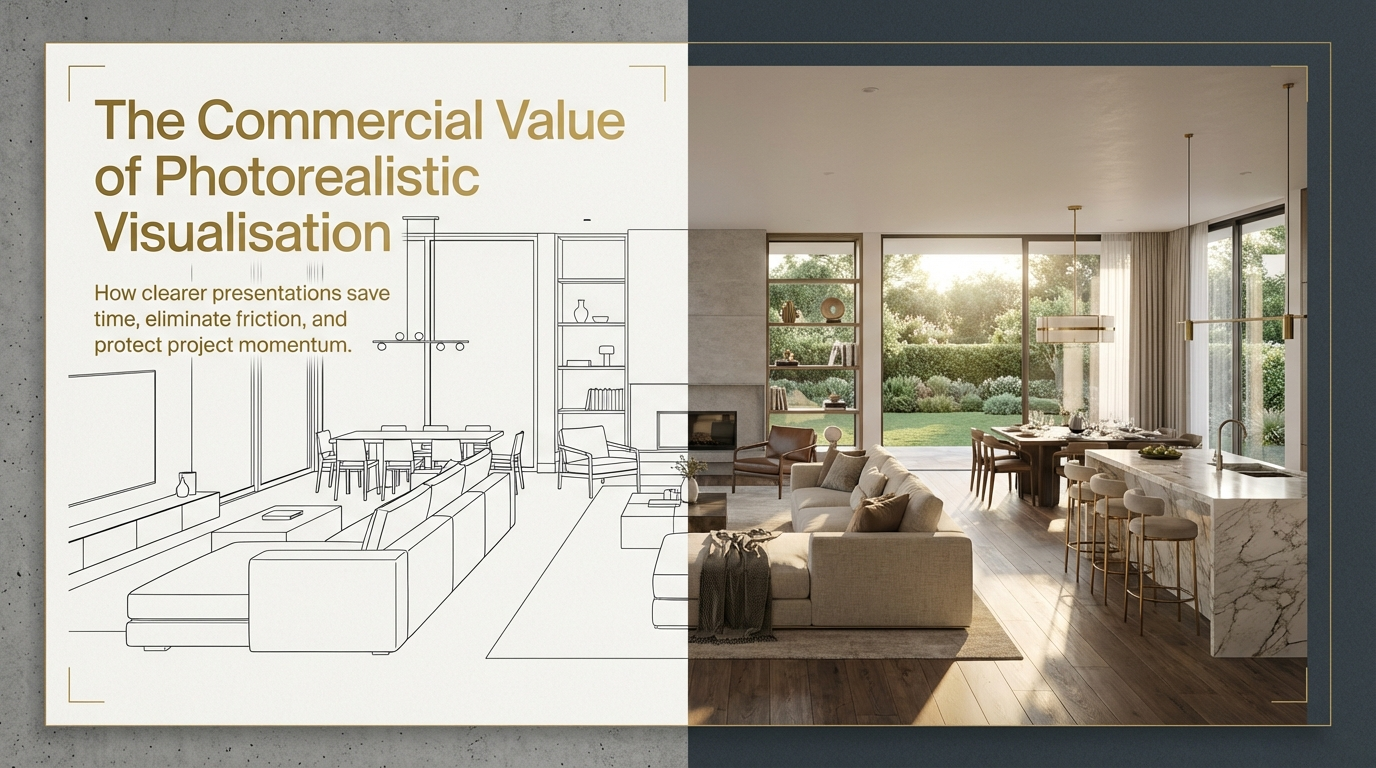
How Photorealistic Renders Save Time, Reduce Revisions, and Speed Approvals
Why basic renders often slow projects down
A basic render can communicate dimensions and general layout.
But that is not always enough for decision-making.
Clients, consultants, and stakeholders usually need more than technical representation. They need clarity around atmosphere, materiality, scale, and how the space will actually feel.
When a render leaves too much open to interpretation, several things tend to happen:
feedback becomes vague
revisions multiply
stakeholders introduce late concerns
approvals take longer than they should
At that point, the problem is not the design. It is the gap between the design intent and what the viewer is able to understand.
How Photorealistic Renders Save Time, Reduce Revisions, and Speed Approvals
Why photorealistic renders create faster decisions
When a render feels believable, the conversation changes.
Clients stop trying to imagine the outcome and start responding to something they can mentally step into.
That shift matters.
Because once the design feels clear, decision-making becomes easier. The client can assess the mood, the materials, the scale, and the visual hierarchy with much more confidence. That usually leads to more focused feedback, fewer unnecessary changes, and faster progress.
In practical terms, stronger renders help by:
reducing confusion in meetings
improving trust in the design direction
making stakeholder feedback more specific
helping approvals happen with fewer cycles
This is why better visualisation is not just a presentation upgrade. It is a workflow advantage.
Better clarity means less revision waste
One of the biggest hidden costs in design and development is revision fatigue.
Every extra round absorbs time from the team. It delays related decisions. It often pulls the project away from its strongest original direction.
Photorealistic renders can reduce that waste because they answer questions earlier.
Instead of relying on plans, elevations, or flat imagery alone, the project team can test whether the space feels balanced, whether the materials are reading correctly, and whether the design communicates the intended level of quality.
That kind of clarity helps eliminate the classic loop of:
brief, present, confuse, revise, repeat.
Better renders also support faster approvals
Approvals tend to slow down when stakeholders are unsure what they are approving.
The more realistic and precise the visual communication, the easier it becomes for clients and decision-makers to understand what is being proposed.
That matters whether the goal is:
client sign-off
internal alignment
investor confidence
marketing and pre-sale support
smoother planning conversations
A render that builds confidence reduces hesitation. And hesitation is often where timelines begin to leak.
Why this matters for Interior design studios
For Interior designers, the value of a render is not simply aesthetic.
It is commercial.
A stronger image can help communicate value earlier, support approvals, present the project with more authority, and reduce the friction that comes from unclear expectations.
When clients and stakeholders understand the vision sooner, the project has a better chance of moving with momentum.
That is where visualisation starts affecting return on investment, not because the image is prettier, but because the project spends less time stuck in uncertainty.
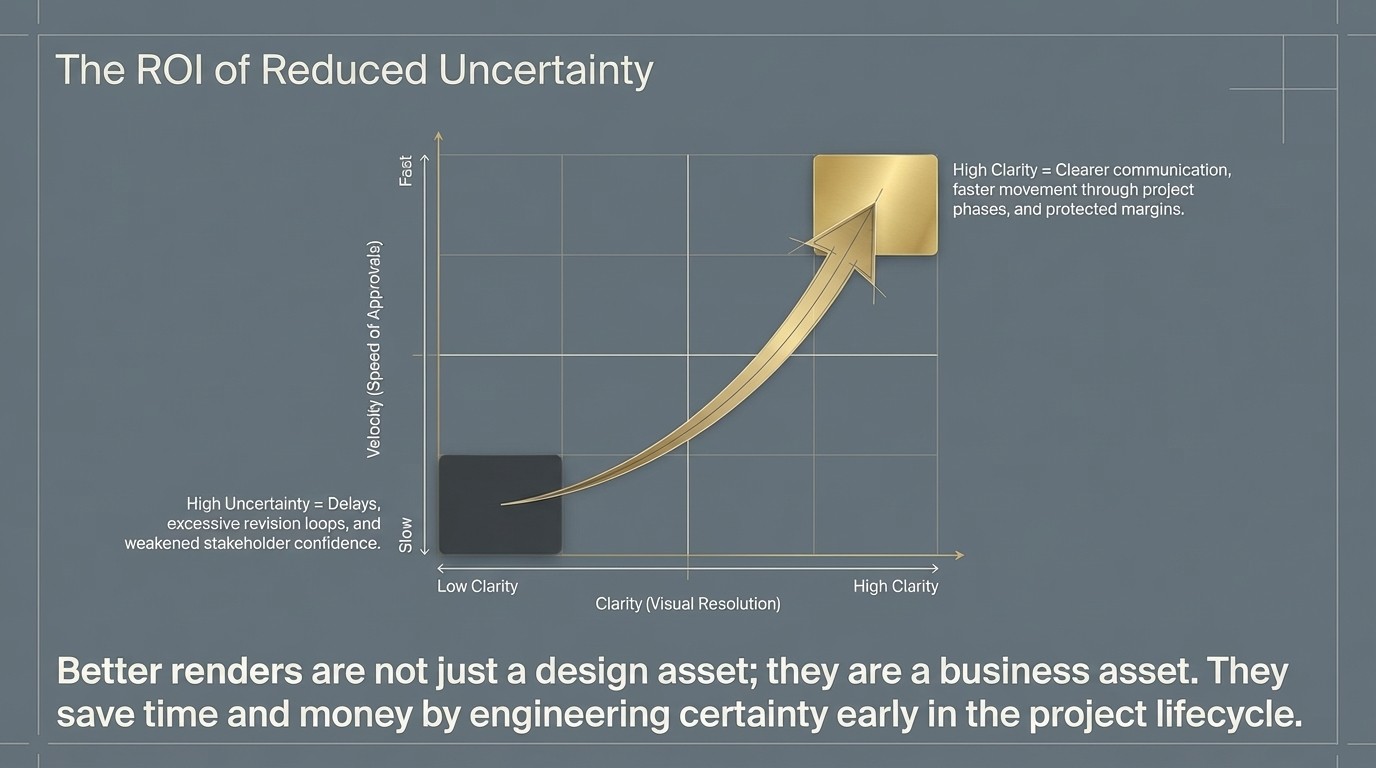
Why photorealistic renders create faster decisions
In Adelaide, clarity is a competitive advantage
In a market where many studios still rely on basic presentation imagery, stronger visual storytelling can create a clear edge.
The firms that present with clarity tend to:
build trust faster
communicate quality more effectively
create stronger first impressions
move projects forward with fewer delays
In that sense, better renders are not just a design asset. They are a business asset.
What good renders actually do
A strong render should do more than fill a board or decorate a pitch deck.
It should help the viewer:
understand the design immediately
feel the intended atmosphere
read the scale and materiality correctly
trust the direction enough to make a decision
That is the real benchmark.
If the image looks nice but still leaves the client uncertain, it is not doing enough work.
Final thought
The value of a better render is not only visual quality.
It is what that visual quality unlocks:
clearer communication
fewer revisions
stronger stakeholder confidence
faster movement through the project
In other words, better renders save time and money because they reduce uncertainty.
And in design, uncertainty is usually the most expensive thing in the room.
FAQ
Do photorealistic renders reduce design revisions?
They often help reduce unnecessary revisions because they make the design easier to understand early, especially around mood, scale, and materiality.
Why do realistic renders help with approvals?
Because clients and stakeholders can make decisions more confidently when they can clearly visualise the final outcome.
Are basic renders enough for client presentations?
Sometimes, but if the project depends on emotional buy-in, material clarity, or premium positioning, basic renders often leave too much open to interpretation.
Who benefits most from photorealistic renders?
Architects, interior designers, builders, and developers all benefit when clearer visuals lead to faster feedback and smoother approvals.
If your projects are getting delayed by unclear presentations, revision loops, or hesitant client feedback, I help Interior design studios use photorealistic visualisation to create clearer decisions and faster momentum.